“You can so alienate yourself from a poem that you stop seeing the poem at all and instead come to see in its place just theories, messages and formal tropes. Stop hearing the music and hear only tonalities and harmonic shifts.”
– Iain McGilchrist
Featured Artwork

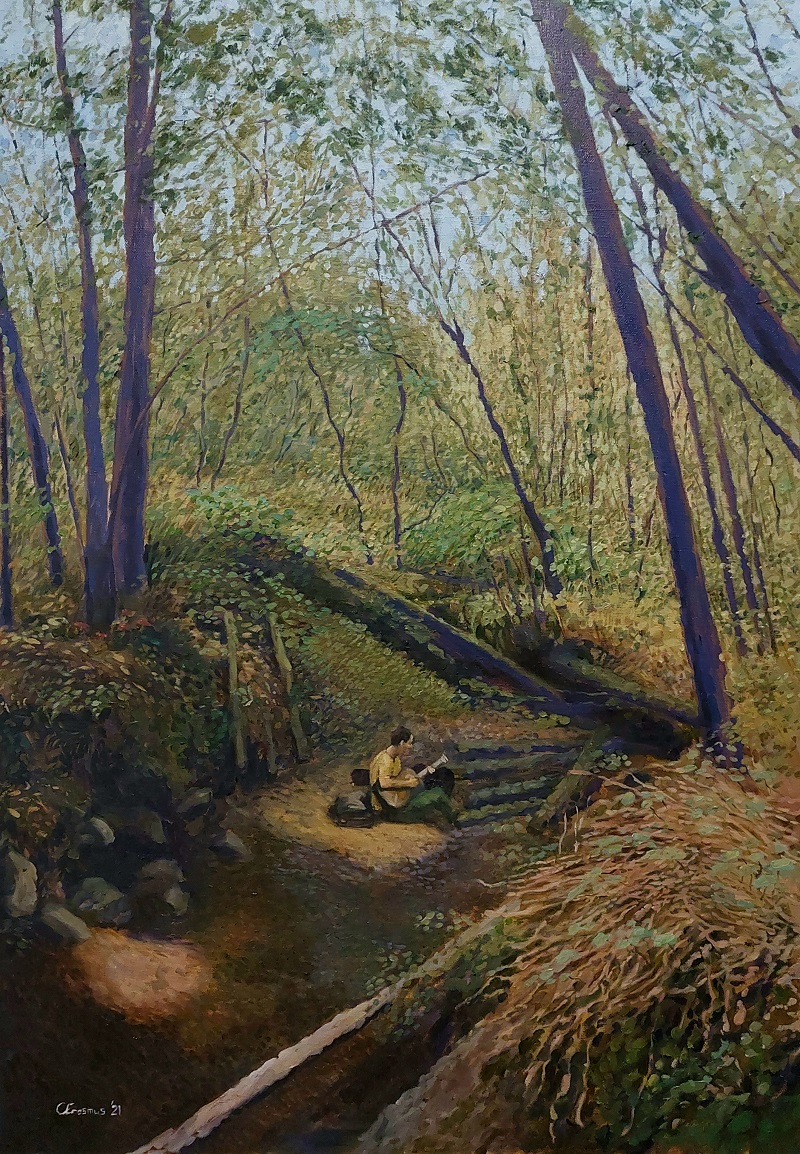
South African Landscape Series – Between Trees
R2200.00
Title: “South African Landscape Series – Between Trees“
Size: 80cm x 57cm
Medium: True Matt Hi-White 230gsm Print
Limited Edition 10
Explore my art collection.

Figures
Drawing on the classical education I received in art school, I endeavour to infuse my work with a rich understanding of anatomy. What fascinates me about depicting the human form is the way in which it embodies a paradoxical interplay of liberty and restraint. While the expressive use of colour and gesture can be deeply liberating, achieving a nuanced balance between the underlying bone and muscle structure requires a deft and deliberate touch. For me, it is a constant striving to achieve this ideal synthesis of form and movement in my work.
Abstract
Abstract art has long been plagued by suspicions of charlatanism, and all too often is dismissed as the work of lazy, untalented artists seeking to dupe unsuspecting audiences. However, in many ways, abstract art has been humanity’s most ubiquitous and enduring form of decoration – from the intricate clothing patterns of indigenous cultures to the vibrant stained glass windows of Notre Dame. Yet, creating a masterpiece within this challenging genre is no easy feat. Artists such as de Kooning, Picasso, and Pollock stand out as masters of the form, whose work resonates deeply with viewers. Despite this, I find myself most uncertain when attempting abstract painting, as the unbounded nature of the medium and my unwavering belief that all art can be differentiated by quality make it a daunting task. While there may be no definitive line one should not cross in abstract art, there is no denying that a Pollock painting can stir one’s emotions more deeply than a work found at a local art fair. For me, most of my abstract work lies at the intersection of the representational and non-representational, with one foot in the uncharted mysteries of abstraction and the other in the familiar comfort and beauty of realism.
Landscapes
Two opposing views on art have persisted throughout history – the belief that art is merely an imitation of nature, and the contention that art is founded on a concept of the ideal. Raphael echoed this dichotomy when he stated, “There are two principles of ideal art: the choice of the most beautiful and perfect propositions of models, and a purely abstract idea” in the 1500s. While I do not believe either view is wholly accurate, these ideas provide an excellent framework to guide one’s approach when creating landscapes. After all, a landscape must necessarily imitate nature, but a discerning eye can also selectively include or exclude elements in order to achieve a heightened sense of beauty. In this way, the principles of ideal art serve as useful guideposts for exploring the boundaries between naturalism and abstraction in landscape painting.
Subscribe to my newsletter
Stay up to date with all my latest exhibitions, artworks and new releases.